


The Electric Scrap-Experts
Customer Story: Switzerland
Shredded and recycled. Recycling company Immark specializes in recycling electrical appliances and electronic devices, and is the Swiss market leader. To shred appliances Immark uses a Komptech Terminator direct SL that breaks up everything from electric motors to dishwashers, making it easier to access the valuable materials inside.

Image: Dependable start – The Terminator is the first step in the recycling process.
Immark AG leads the Swiss market in processing used electrical appliances and electronics like refrigerators, air conditioners, computers, televisions, dishwashers and photovoltaics, gathered from collection points and retailers. The useful life of discarded appliances and devices is not over – on the contrary, depending on the item up to 95 percent of the materials can be reclaimed and up to 80 percent recycled. Precious metals, aluminium, copper, iron and plastics are separated out and processed into secondary raw materials. Special and non-recyclable wastes go to thermal reclamation.

Image: Patrick Wollemann from Immark (right) and Yvan Grepper (left) from GETAG (Komptech sales partner in Switzerland) in front of the Terminator direct SL.
BREAKING IT DOWN
The route from discarded appliance to new secondary raw materials, such as can be used by smelters or steel works, is long. First hazardous materials including capacitors, batteries, propellants like CFCs and even asbestos must be removed. Appliances are then disassembled in multiple steps and the parts sorted, in some cases manually. For this process, the company, which belongs to the Thommen Group, called on GETAG Entsorgungs-Technik AG, Komptech‘s exclusive sales and service partner for switzerland and has obtained practical help from Austria in the form of a Komptech Terminator direct SL. This low speed single-shaft shredder can be used on all types of waste, including industrial and commercial waste. At Immark’s Regensdorf location it is used to break up discarded electric appliances to open them for the downstream sorting machines.
Patrick Wollemann, Technical Team leader at Immark, puts the shredder’s task succinctly: “First and foremost we have to break open the appliances. That way we can sort out hazmats as well as recyclables like built-in batteries, capacitors, electric motors and transformers.” Then comes the next shredding step, which enables separation into clean fractions like ferrous metals, non-ferrous metals and plastics. After three modules the material then goes to the “mill”. Patrick Wollemann describes the remaining process: “There we granulate the fines, which we again separate into plastic and metal by means of density separation. We sort the metal into light and heavy metals and then make a high-quality granulate.
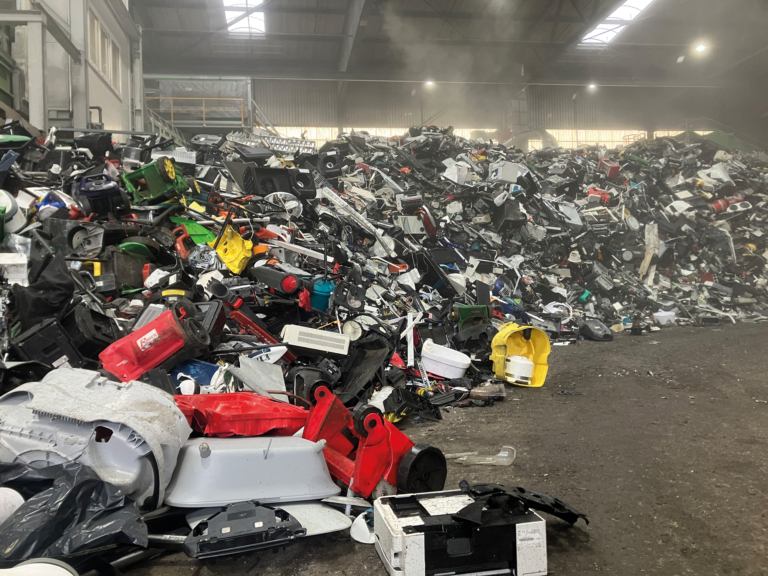

Image: This is where recycling begins – collection area for pre-sorted old appliances.
PUT THROUGH ITS PACES
The Terminator from Komptech, which performs the all-important shredding step, was not an unknown quantity at the company. A mobile Terminator 5000 S had long worked for the Thommen Group, which has a footprint in five countries. A Terminator with hydraulic drive had also been successfully tested at a plant project in Dubai. Now the company was looking for a stationary solution, and the choice fell on a Terminator direct SL. “We were actually happy with hydraulic drive, but the direct drive model’s energy efficiency, maintenance-friendliness and torque ultimately won us over,” recalls Patrick Wollemann. Before “onboarding” in Regensdorf, the Komptech shredder was put through its paces. “We ran various tests with a wide range of materials and were impressed most of all by how it opened input materials up, what the output was like, the high throughput, and the energy-saving drives with over 90 percent efficiency.” Wollemann, a mechanical engineer by training, praises not just the performance and degree of shredding of the 220 kW machine, but also the good interior access and simple handling. Another plus point was the local contact staff. “It was important to us to be able to rely on service in Switzerland, which GETAG offers,” says Wollemann.

Image: A constant stream – Conveyors move electric waste for an efficient material flow.
CHALLENGES MET
However, some time passed before the Terminator, despite its impressive 12 tonnes per hour throughput, could meet all of Immark’s demands. This was due to the inhomogeneity of the appliances the Terminator had to deal with. “To prevent contraries like iron or large electric motors from damaging the machinery, the entire shredding unit had to be modified and reinforced,” says Wollemann of the initial challenges. “But we never felt like we were left to our own devices. For one thing, GETAG service technicians were always on hand quickly to help us out. For another, Komptech immediately got to work on a solution, and not in a black box either – they worked with us and with the design department of our system builder.”
The result? A new, very tough machine with which Komptech demonstrates its capabilities in the processing of discarded electrical appliances. The new shredding unit has been in use for over half a year with clear success, as Wollemann relates: “Our machine is always on the job now and runs very well.”
„Komptech is a very down-to-earth, solution-oriented company.“
Patrick Wollemann,
Technical Team Leader at Immark
BIG MACHINES, BIG VISIONS
The Terminator doesn’t let anything stop it, and that’s a good thing. This sustainable company, which draws most of the electricity it uses from its own photovoltaic system, has ambitious goals for recycling. “We want to continue to move the recycling needle up by means of innovation and new technologies,” says Patrick Wollemann. While a one hundred percent recycling rate may be an unreachable goal, the company does want to support customers as they move into sustainable industry, and continue to sharpen the focus on the circular economy. “That saves worldwide resources, while also generating new ones,” explains Wollemann. Reuse means fewer primary raw materials need to be extracted and imported into Switzerland, and thus Immark makes a major contribution to protecting the environment. And all the while, in the middle of Switzerland’s largest electric appliance waste processing plant a Terminator steadily crunches along, doing its part for sustainability.

This is the online version of the article “The Electric Scrap-Experts” from the Komptech magazine Opportunity / Issue No. 4 (2025) ↗
Image rights: All images © Komptech GmbH where not otherwise indicated.
No liability accepted for changes or errors.
More news

A Strong Collaboration That Has Lasted for Decades
The serial number 1 is found unusually frequently on Komptech machines at Munich’s Schernthaner GmbH. Why? Because Komptech and Schernthaner have a 30-year history of collaboration in operation,
communication and improvement.

Innovative Star Screen Technology for the US Market
Mulch production in the USA has been booming for years, and new recycling technologies for organic waste are in higher demand than ever. The new Komptech Multistar star screens help generate high-quality, homogeneous mulch from biomass.

A dependable partner in all weathers
Vienna’s Neustädter Stadtwerke und Kommunalservice GmbH (WNSKS) has collected waste for over 70 years, and now does so from 36 municipalities. They process it using several Komptech machines, from Topturn to Terminator.

Enabling Value Creation from All Types of Waste
Zeller Recycling GmbH offers all the services along the waste collection value chain – container service, transportation, reclamation and processing of waste.

A Year in Our New Headquarters – A Retrospective
It’s been about a year since most of the Komptech team moved to the new headquarters. Bernhard Muhr, Head of Group HR and member of Project Management for the construction of the new building, looks back on 12 eventful months.

Dr. Rückert is a professor of Cyber Physical Systems at the University of Leoben. He explains what matters with AI and robotics and what upheavals are coming our way.

